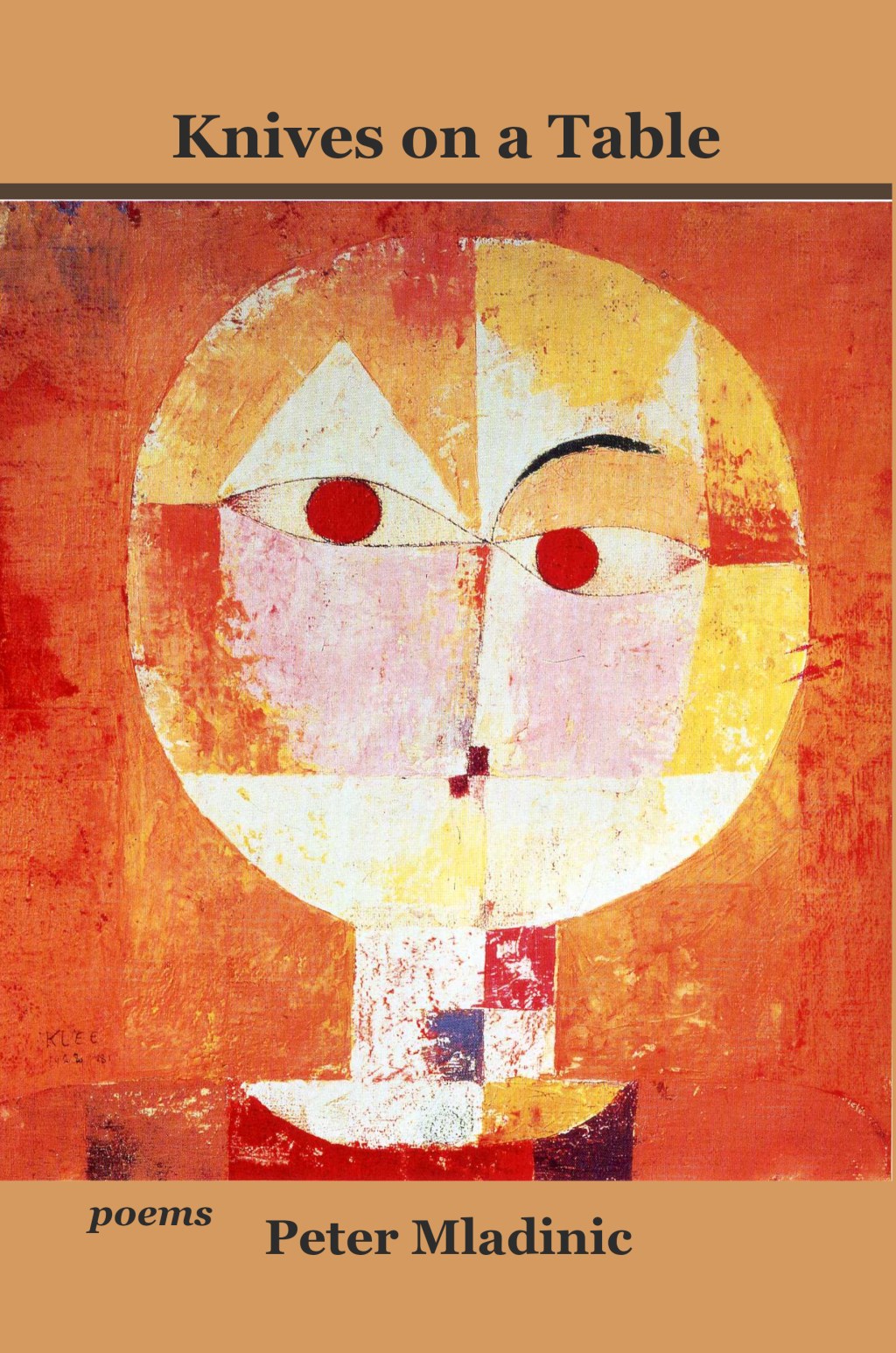
Right out of the gate, Mladinic’s textured collection of poems invites the reader to sit up and pay attention. The striking cover, Klee’s «Senecio,» sets me up for a world that’s both humorous and dead serious. I enter this world with one eyebrow raised, a little off-kilter and alert to any danger, yet warm like the oranges, reds, and yellows of the cover art. The title, Knives on a Table, also evokes the idea of danger, as I am left to choose whether to imagine butter knives at a formal Sunday brunch, or a series of butcher knives or Bowies ready to go to work, or anything in between. And the word knives is just about the best word ever; whenever I see it, I remember a moment from Canadian poet Roo Borson’s «Blackberries:»
The eucalyptus shadows hang
like knives, knives that cut nothing,
shadows.
What a great word on the tongue! In the Borson, as in the Mladinic, I am reminded that it is not the knives (or the guns or any other weapon or tool) themselves that are dangerous, but rather the human force that chooses to wield them. They sit there on the table, inert. Or they hang in the tree, cutting up shadows, somehow threatening us, which is also a concept woven throughout the Mladinic. We get a hint of this in the Table of Contents. (I love tables of contents, and Knives does not disappoint, with such jewels as «Trotlines,» «GI,» «Mike Tyson Inside,» «The Tylenol Murders,» «Pit Bull,» «Tweakers,» and «Sign of the Jaguar,» to name a few).
In the title poem, which arrives about midway through the book, the speaker picks up a knife and immediately says «I love you and want to kill you.»
Oh, yes, I understand this, as a reader. I have my own version of this, for sure.
«I love you, and often I hate you.» Oh, yes, again. Here is the complexity of intimate human connection, the joy and the pain of living on this earth. The knives are always there for us, as are the dark thoughts that
              ...resemble knives,
rose petals,
small dead birds on dry grass.
and
           ... rags in a shed
two parakeets in a cage,
and later, in the second section of the two-part title poem, dark thoughts
can be loving or spiteful.
I've been stung by a dark thought,
kissed by a dark thought, fooled
and saved. Dark thoughts are thorns.
They're jet wings
at 36,000 feet. Clumps
of dirt thrown on a casket,
the mourners' veils,
the gravediggers' boots, the shined shoes
of the corpse.
So, knives are thoughts are thorns are poems are spiritual powers, etc. They exist. They lie on the table, they shift in the trees, they are everywhere, waiting for us to choose.
In the first poem, «Box,» the speaker strikes a casual and inviting tone, using such phrases as «at any rate» and «as you know». In this way, the poem asserts itself and implies that putting thoughts into boxes (disparate thoughts like memories of rivers and parents and war and love) is a perfectly normal and acceptable thing to do. As you certainly know, reader, it seems to say, we all do this. Some of us do it to cope with the haunted present, others to make sure to preserve sweet memories, and yet others perhaps to assert some kind of control over an institution like the church. And writing a poem, it seems to me, is a way of putting thoughts into boxes. This lovely and sonically pleasing poem, repeating the half-rhymes «thoughts» and «box» throughout, serves to open my mind to the complicated roads ahead.
And these roads lead in many directions, ultimately reunited by the fierce imagination and voice of the poet. Always, those knives cast their shadows. Whether we are looking into the world of the living through the eyes of a murdered child as in «Bobby Greenlease,» or speaking to ashtrays as an ex-smoker as in «Big,» or gazing into the kitchen of a worried mother as in «Nephritis,» we hold the world’s complexity in our hands. Where there is trouble, there is also peace and surrender. Where there is terror, there is also comfort. Look, the poems say, see how brief our lives are. Look how vulnerable we are and how quickly trauma can happen. Or, how shit can happen, as in «Pull Over:»
Pull over in daylight.
Take the exit ramp.
Pull over. I need to tell you something.
Pull into the rest area, please.

By the time you get back
Into parkway traffic,
life as you've known it
will have taken flight.

Finding home, Poe's raven
perched on your roof.
Words can't silence its caws,
nor can summer thunder.
Of course, all of us are vulnerable to that phone call after which nothing is the same. We may all have our own version of pulling over, after which life as we’ve known it is completely finished, and we must move into a new world. This is the human being surviving, understanding the new normal and following breadcrumbs down the path, hoping for the best while knowing that our defenses against deep pain and suffering are truly thin. However, we continue showing up, as we must, if we choose to.
In my own experiences with trauma, I’ve learned that while I can’t control the world, with help I can choose how to respond to it when shit happens. I’ve learned that help can arrive in many forms, one of which is the art of poetry and, for this reader, Knives on a Table is a balm. After all, a book that contains Brylcreem, Corvettes, Marlboros, discoes, Quick Stops, Chryslers, rivers, back paths, the Celtics, and George’s beer garden, among many other wonders, has got to be a journey worth taking. Like sun reflected off the bus windows, it breaks the whole sky into rectangles before returning it to us, glittering and whole. Through specificity and various voices and melodic insistence, it asks us to remember our own pasts and perhaps to re-shape them, to find its most beautiful boxes, to choose a new lens. And like the best poetry should, through sound and image, it moves us from lonely to lovely to lonely, again and again.


 LatinosUSA
Deja un comentario