Hi, all:
I bring you another book I’ve discovered through Rosie’s Book Review Team, and it is a pretty special one.

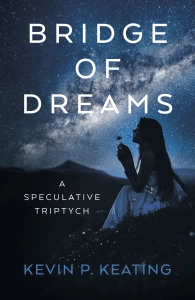
Bridge of Dreams. A Speculative Triptych by Kevin P. Keating
Comprising three interlinked novellas, Bridge of Dreams: A Speculative Triptych centers around a young woman who embarks upon a spiritual quest over the span of three different lifetimes. In Gwendolyn Greene and the Moondog Coronation Ball of 1957, the Soviets are preparing to launch a dog into orbit. The Americans, in an attempt to stay competitive in the space race, select a remarkably intelligent dog owned by a 14-year-old girl from rural Ohio. But only Gwendolyn can explain the mystery behind her beloved canine’s extraordinary gifts. Hilda Whitby and the Heavenly Light of 1857, takes place in an Ohio frontier town and concerns the trials and tribulations of a brilliant female chemist who has just lost her son to a devastating explosion. Wanted for questioning by authorities, Hilda travels along the Erie Canal, meeting an assortment of curious characters until one fateful night when she faces a strange destiny inside a cave. In IMPETUS 13 and the Constitutional Crisis of 2057, a timid college student and an assertive professor of creative writing set out on a road trip only to discover what appears to be a flying saucer stranded deep in a remote canyon.
About the author:
After working as a boilermaker in the steel mills in Ohio, Kevin P. Keating became a professor of English and began teaching at Baldwin Wallace University, Cleveland State University, and John Carroll University.
“The Natural Order of Things,” his first full-length book, was a finalist for the Los Angeles Times Book Prizes/First Fiction Award. The novel has garnered starred reviews from Publishers Weekly and Booklist and praise from Pulitzer Prize-winning author Robert Olen Butler.
His second novel “The Captive Condition” releases as a Pantheon hardcover original and was featured at the 2015 San Diego Comic Con International.
His forthcoming novel, “Bridge of Dreams: A Speculative Triptych,” will be released in May 2025 by Bernardo Kastrup’s iff Books.
He currently resides in Cleveland, Ohio.
My review:
I write this review as a member of Rosie’s Book Review Team (author, check here if you are interested in getting your book reviewed) and thank her and the author for this opportunity.
This is my first contact with this author, although as stated in his biography, he has written and published other books and stories before, with much success.
In fact, one of the stories in this book, which he describes as a speculative triptych, and I can’t think of a better way of defining it, had been published as a novella in its own right before, and was well received.
Before I go into more detail (and I am not going to talk too much about the specifics of the stories, because reading them is a journey the reader has to embark on solo), I can summarise how I feel about this book. I loved it. I am not sure I’d say I got all the connections and all the references it contains, but I was happy to jump in and let it take me on a wild ride, back and forth in time. Because if I try to think about how to define the experience of reading it, several words and concepts come to mind: kaleidoscopic (depending on how you twist it, the image you see changes, but some elements remain recognisable), a crazy-quilt (each fragment has a distinctive story behind it, but together they create something that might seem random, but it has a definite pattern), and it also makes me think of Escher’s impossible drawings (because you seem to know where the story is taking you, and suddenly you discover you are somewhere else).
The book contains three novellas, but also a dedication and quote (which hints at how science views anything that cannot be easily explained using the scientific method); a brief section of acknowledgments; a foreword, by M.E. Pickett, editor and publisher of a magazine where Keating has published stories before (including one in this book); the introduction; a postcript; and a section about the author.
The introduction comes with a warning from the editor, explaining that the author’s note might give clues as to what happens in some of the stories. I read it, nonetheless, and as I was reading the stories later, I didn’t regret having read it. Because, in this introduction, the author explains (realistically or not, readers can decide), how the book came to be, and also how the order of the stories was decided. Because the stories take place over a period of two hundred years, but we don’t read them (if we read them as they are published, although the author gives us permission, following his daughter’s wise advice, to read them in any order we choose), in chronological order. We start by reading what is called ‘first trip’ the story of ‘Gwendolyn Greene and the Moondog Coronation Ball of 1957’, then we read the second trip, which tells us the story of ‘Hilda Whitby and the Heavenly Light of 1857’, and we finish by reading the final trip, ‘IMPETUS 13 and the Constitutional Crisis of 2057’, so we go back and forth in time. All the stories have female protagonists, although the first one is narrated by a writer who remains unnamed and is telling us the story many years later (and yes, the story talks about a dog chosen to be sent to the moon as part of the space race between the USA and the USSR), and the other two are told in the third-person, always from the perspective of the female protagonists (however, both, Hilda and Maggie, experience events that might not correspond to reality. What reality is and what consciousness is, are some of the questions these stories keep bringing up. And there are no easy answers).
I followed the order set in the book, and it worked well for me, as I felt the final trip seemed to bring together many elements of the story, but I keep wondering if I would have felt the same no matter the order I had chosen. I am sure the stories can be read independently, but the three of them together become the triptych the author wanted to achieve, and each one of them makes you question what you had read before and the rest of the stories. And then, the postscript, which is purported to be a collection of handwritten notes by the author, left without much of an explanation, offers us an intriguing origin or creation story of how the book came to be. Make of it what you will.
The stories are beautifully written, and one of the joys of reading them is trying to find connections and identifying common elements between the characters, locations, and their experiences. We keep revisiting places, listening to stories, meeting peculiar characters, and seeing how beliefs and explanations change over time. There are elements of historical fiction (the first and second trip are anchored in recognisable historical periods, although some of the events might not be ‘realistic’ in a strict sense), and of science-fiction (although the third trip feels both, alien and quite familiar, and in that, we share Maggie’s perception and the way she feels).
I could go on and on, and I realise I haven’t given people many specifics about the stories. Still, if I had to highlight a few things, beyond the beauty of the language used to describe settings, states of mind, natural and hallucinatory (?) experiences, I would mention: the combination of recognisable emotions and relationships (friendships, guilt, loss, grief, motherhood, fear, confusion, shame, regret, trying to make amends…) with fascinating flights of fancy and unexplained events; the coming-of -age stories of three female protagonists looking for knowledge, self-definition, and control over their own lives; the search for personal truth as distinct from the official truth; the power of the mind, imagination, and creativity as opposed to materialism and rational explanations. Don’t think this means the stories are heavy-going and hard to read. They are likely to leave you thinking for a long time and wondering what exactly you have read, but they are all gripping, fascinating, and very different from each other. And there is plenty of humour and moments that will make readers smile as well.
Anybody who loves speculative fiction should give it a go. Anybody who appreciates beautifully written stories and characters, and who appreciates straying away from reality every so often, should read it. And, anybody who feels curious about the description and wants to try a new reading experience should read it as well. (As I usually advise, if you aren’t sure, read a sample of the book. I did, and I don’t regret it).
Thanks to the author for this book, thanks to Rosie and the members of her team for all their support, and to you all, thanks for visiting, reading, sharing, commenting, and for always being there. Keep smiling and takes lots of care.


 LatinosUSA
Deja un comentario