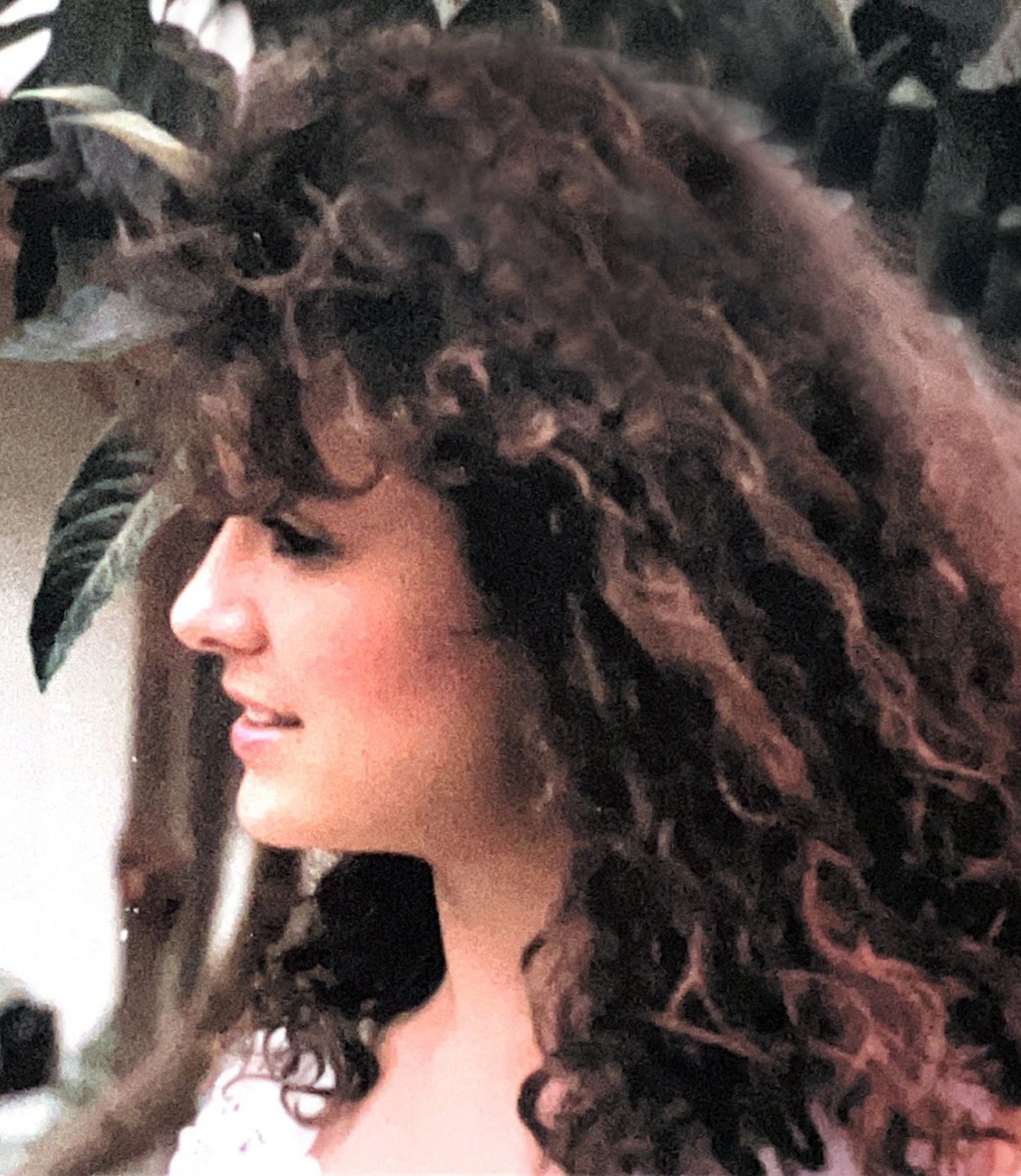
J. Re Crivello: Do you think poetry is back in fashion?
Kimberly Vargas Agnese: While studying to be an educator, I was taught to encourage every child that a writer lived within them, that writing was thought — and I believe that this philosophy has taken root in our present society.
J R C: Do you write poetry daily, or do you write as ideas come to you?
Kimberly Vargas Agnese: This poetic world in which we breathe constantly bears fruit. Metaphor and meaning surround us. That said, although I appreciate the wonder of the flower songs the earth is taught to sing, I cannot gather them all at once… so I listen more often than write.
J R C: What is your next publishing project? Could you tell us how it came about?
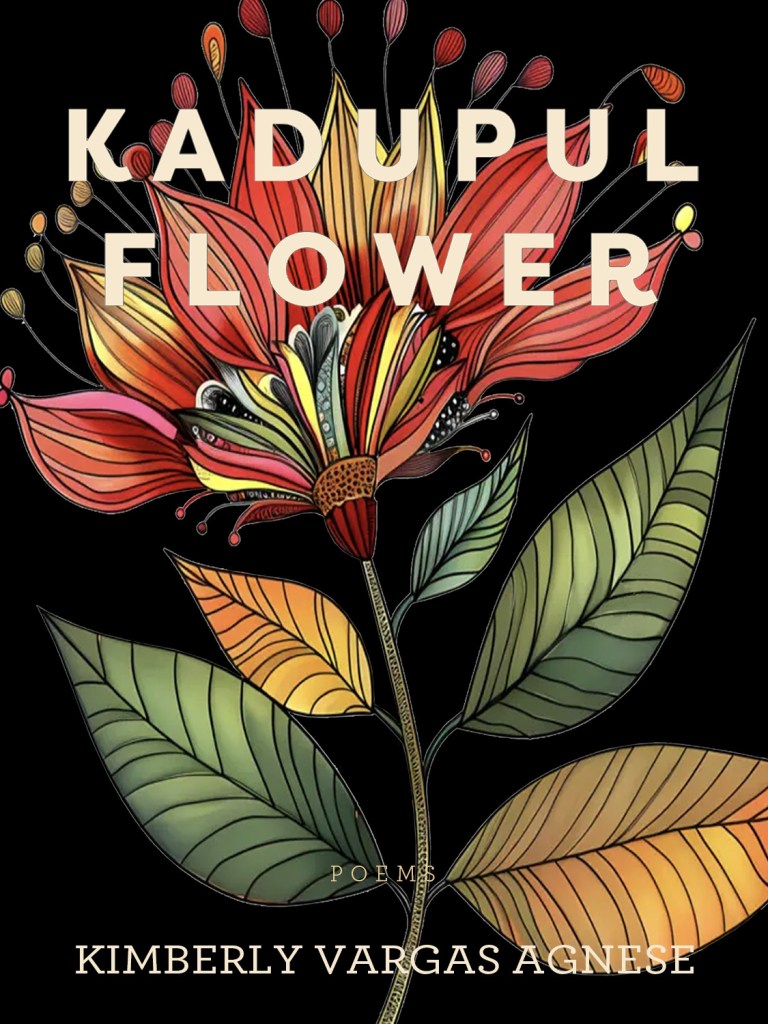
Kimberly Vargas Agnese: My daughter, Stephanie, is also my agent. She and I are presently partnering with my publisher, Green Writers Press, in readying my poetry collection, Kadupul Flower, for launch. I’m not quite sure what direction we will go after that. We have talked about a collection of my NPE (Not Paternity Expected) poetry, which explores life in the wake of a DNA surprise. We’ve also discussed doing a Christian devotional, but I am not entirely sure what’s next.
J R C: The city you live in, and a description of your favorite bar or café.
Kimberly Vargas Agnese: Does a juice bar count? As a plant-based consumer, my go-to would be Jamba Juice in Clovis, California. It’s a small, fresh-faced restaurant where one is guaranteed to come away with a green smile after drinking wheat grass. It’s often our go-to when celebrating publications. 🙂
Kadupul Flower by Kimberly Vargas Agnese
What if a trickle of water streams over the lip of my roof,
filters through beaks of year-old doves standing on the edge of our rain gutter,
instead of from one of those high-end luxury ponds?
On the other side of the good pane,
(the one that doesn’t have a dried leaf
taped to a piece of binder paper to cover the crack)
water falls between fingers of Mexican fronds,
warbles over greenery about six feet away from the Bible
which sits on our kitchen table.
With the last $5.48 left on our food stamp card,
I can buy masa and lard to make chochoyotes that should stretch us ‘til Thursday.
In Genesis, it says
Let the water under the sky be gathered into a single basin
and Let the earth bring forth vegetation, every kind of plant that bears seed.
But The New York Times says that cuttings from Ecuador cost $200 a-piece.
I read somewhere that a Juliet rose could cost 15 million.
Everyone buying and selling the Creator’s stuff.
Probably not a good idea to plant a Kadupul flower in a bog garden.
In Mexico, that cactus grows between tree branches and rock crevices,
considered priceless.
Author Biography
Kimberly Vargas Agnese is the author of Kadupul Flower (Green Writers Press, 2025) and was named a finalist for the 2022 Andres Montoya Poetry Prize. Her writing appears in Common Ground Review, Anacua Literary Arts Journal, and Awakened Voices Magazine, among others. Kimberly resides in Fresno, California, where she cultivates a young food forest, along with her adult daughter. Online, she blogs at www.mocassinsatmeadowarc.com.
Performance
Kimberly will be participating as a panelist at the Fresno Writers Summit (Fresno State University, Sept. 27th, 2025).
Author Interviews, Blog Post · May 22, 2025
Interview:
Kadupul Flower: Kimberly Vargas Agnese on Poetry, Poverty, and Environmental Justice


 LatinosUSA
Deja un comentario